Most people blame clutter when a home feels tight. Too much furniture. Too many things. Not enough storage. What rarely gets questioned is the way rooms are allowed to open and close. Doors, especially traditional hinged ones, quietly consume space every single day without ever being noticed.
A standard swing door needs clearance. That clearance is not theoretical. It is real floor area that cannot be used for furniture, walking paths, or storage. In a large house, this loss fades into the background. In a compact home, it dictates how a room behaves. Beds get pushed into corners. Bathroom vanities shrink. Desks sit at odd angles. The door decides first. Everything else adapts.
This is where the problem begins. Swing doors don’t just open and close. They interrupt flow. They force movement patterns. They create dead zones along walls that can never be fully used. Over time, homeowners adapt so completely that the door becomes invisible. The frustration stays, but the cause disappears from awareness.
The issue becomes clearer when rooms have multiple functions. A guest room that doubles as a home office. A laundry area that shares space with storage. A bathroom that needs to feel open without sacrificing privacy. In these cases, door swing dictates whether the room feels flexible or constrained. Hinged doors lock the layout into a single mode.
This is why designers often reframe the question. Instead of asking how to make a room bigger, they ask how to stop wasting the space that already exists. One answer that keeps resurfacing is sliding pocket doors, not as a design statement, but as a spatial correction.
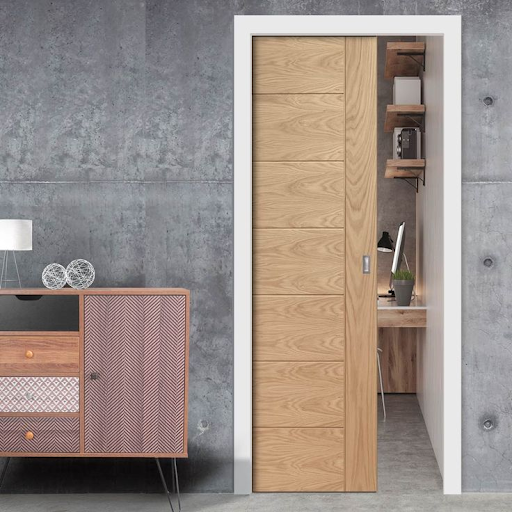
By moving the door into the wall cavity, the room regains its edges. Walls become usable again. Furniture placement stops revolving around an arc of clearance. Circulation paths straighten out. The change can feel subtle at first, but the cumulative effect is significant. Rooms behave differently when they are no longer negotiating with a swinging panel.
Bathrooms show this shift most clearly. In small bathrooms, the door often competes with the toilet, vanity, or shower entry. Removing the swing can immediately reduce visual clutter and physical awkwardness. Bedrooms follow closely behind. A pocketed door allows full use of wall space for wardrobes or shelving, something hinged doors quietly prevent.
There is also a psychological component. Spaces without visual interruption tend to feel calmer. When a door disappears instead of hovering in the room, the boundary between areas becomes intentional rather than intrusive. This matters in homes where every square metre is doing more work than it should.
Of course, not every situation calls for this solution. Wall structure, plumbing placement, and sound insulation all matter. But the mistake many homeowners make is not evaluating the door at all. They renovate surfaces, swap fixtures, and rearrange furniture while leaving the original spatial constraint untouched.
In renovation planning, sliding pocket doors are often treated as an upgrade or a modern preference. In reality, they are frequently a correction to a layout problem that has existed since the home was built. Especially in older properties or compact floor plans, the original door choices were made for simplicity, not efficiency.
What makes this door type powerful is not novelty. It is restraint. It removes something rather than adding more. No extra hardware in the room. No additional furniture. Just the quiet return of space that was already paid for.
When homeowners describe a renovation as feeling “lighter” or “less cramped” without being able to explain why, door behaviour is often part of the answer. A room does not need to grow to feel bigger. Sometimes, it just needs to stop losing space every time a door opens.
For small homes in particular, sliding pocket doors shift the conversation away from compromise. They do not ask what can be removed to make things fit. They simply stop taking what the room cannot afford to give.