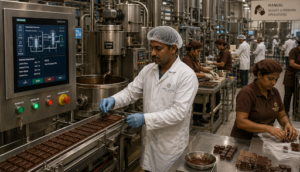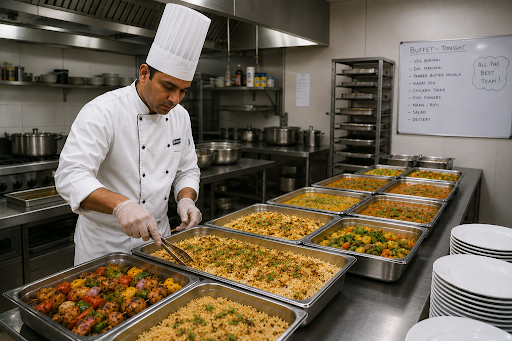
Walk into the back of almost any commercial kitchen after a busy service, and you will find the same thing: hotel pans of food that never made it to a plate. A little extra rice cooked “just in case.” A batch of soup that ran long because the kitchen didn’t want to run out mid-rush. Multiply that across every station, every meal period, every day of the week, and overproduction in kitchens quietly becomes one of the most expensive habits in foodservice.
Commercial kitchen overproduction isn’t usually the result of bad cooks or careless managers. It’s the predictable outcome of a system built on guesswork forecasts based on gut feeling, prep lists that never get revised, and a culture where running out of food feels riskier than throwing it away. Fixing it takes more than telling staff to “cook less.” It takes rebuilding how a kitchen decides what to produce in the first place.
Building Better Commercial Kitchen Production Planning
The single biggest lever to reduce food waste in commercial kitchens needs production planning that’s grounded in real data rather than habit. That means a few concrete shifts.
Forecast at the item level, not just the meal level. Knowing you’ll serve 400 guests at lunch tells you very little about how much of each individual dish to prepare. Effective forecasting breaks demand down by menu item, factoring in day-of-week patterns, seasonality, weather, and known events. The more granular the forecast, the tighter the prep list can be.
Set par levels based on evidence, then revisit them regularly. Par levels shouldn’t be static. They should be reviewed on a rolling basis against actual consumption data, with adjustments made as menus, guest counts, or seasons change. A quarterly review is a reasonable minimum; a kitchen with the right tools can adjust on a weekly basis.
Standardize recipes and batch sizes. Inconsistent portioning and “eyeballed” batch sizes make it nearly impossible to compare planned production to actual need. Standardized recipes with defined yields give kitchens a stable baseline to measure against and help reduce food waste in commercial kitchens.
Stagger production instead of front-loading it. Rather than cooking an entire meal’s worth of a dish at the start of service, many reduce food waste in commercial kitchens by producing smaller batches throughout service and replenishing as needed. This requires tighter coordination between the line and the kitchen, but it dramatically reduces the amount of food sitting unsold at the end of the shift.
Close the feedback loop. This is the step most kitchens skip, and it’s arguably the most important one. Without a consistent way to measure what’s left over after each meal—by item, not just by the total weight of waste —a kitchen has no way to correct its forecasts or par levels over time. Manual tracking (weighing pans and logging waste on a clipboard) can work in theory, but in practice, it’s time-consuming enough that most kitchens abandon it within a few weeks.
Use of a 3D AI scanner. This last point, closing the feedback loop, is where a lot of well-intentioned waste-reduction efforts stall out. Kitchens are busy, staff turnover is high, and manual data collection competes with the actual work of getting food out the door. This is exactly the gap that AI-driven kitchen tools have started to fill.
For example, the Metafoodx AI scanner is positioned at prep and service stations. Before service, staff place each pan on the scanner for 2 seconds, and the scanner automatically identifies the menu item along with its weight and temperature, with no manual logging required. After service, returning trays are scanned again, and any leftovers are automatically categorized as reused, donated, or composted. For kitchens that have struggled to sustain manual tracking long enough to see results, automating the measurement step is often what finally makes improvements in production planning stick.
None of this requires abandoning the instincts that make a good kitchen team good. It just means giving that team better information to work with. A chef who knows, with real data, that the braised chicken consistently comes back at 15% unserved on Thursdays can make a smarter call than one who’s simply told to “cut back a little.” The goal isn’t to strip judgment out of the kitchen; it’s to make sure that judgment is backed by evidence instead of guesswork.
Conclusion
Reducing overproduction in commercial kitchens requires ongoing discipline. The kitchens that succeed at it tend to share a few habits: they forecast at the item level, they treat par levels as something to be tested and adjusted rather than set in stone, and they build in a real feedback mechanism so lessons from last week’s waste actually change next week’s prep list.
Whether a kitchen gets there through disciplined manual processes or through automated tools that make tracking effortless, the underlying principle is the same: you can’t manage what you don’t measure, and overproduction in kitchens thrives exactly where they aren’t measuring.