India has one of the largest foundry industries in the world, of which sand casting manufacturers India supplies a wide variety of products, ranging from automative brackets to large pump casings. Sand casting remains as the go-to method for metal component manufacturing due to its affordability, design flexibility, and applicability to all types of castable alloys such as cast iron, steel, aluminium, and bronze. In this article, we highlight the sand casting process flow, materials, and why companies choose to buy from sand casting manufacturers India.
By choosing the right sand casting manufacturers India, customers can benefit from the process’s ability to offer consistent material properties, dimensional accuracy, and competitive pricing for any order size.
What Is Sand Casting?
Sand casting is a metal forming process that uses sand as a mould material. Molten metal is poured into a cavity formed by compacted sand, permitted to solidify, and the casting is retrieved by breaking away the sand mould. It is one of the oldest metal manufacturing processes that remains popular for its versatility and cost-effectiveness.
A pattern is placed in the sand and forms a cavity, which is subsequently filled with molten metal. Once the metal has solidified, the sand casting is extracted by breaking away the sand, a process referred to as shaking out. While the basic process has remained the same, several advancements have taken place over the years in pattern making, sand preparation, mould assembly, and quality inspection.
The Sand Casting Process, Step by Step
- Pattern making
A pattern, which is a replica of the part to be manufactured but larger in size by 10–15% for shrinkage, is placed in sand to form a cavity. Patterns can be made of wood, metal alloys, or plastic.
- Mould preparation
Sand is mixed in with binders such as clay or resins and packed around the pattern. The sand mould is typically made up of two halves, namely, the cope and the drag. Additional cores made of sand can be placed inside the mould cavity to form internal cavities in the casting.
- Melting and pouring
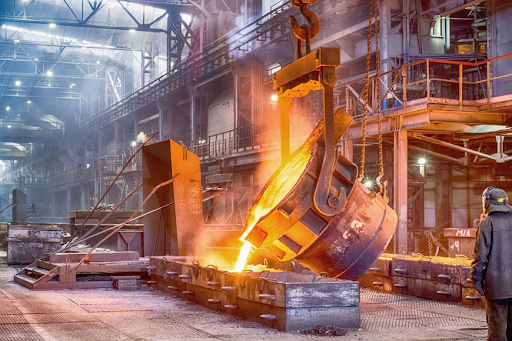
The metal is melted and poured into the sand mould cavity through a gating system, which regulates the rate of flow of the molten metal.
- Solidification and cooling
The casting is then left to cool and solidify until it reaches the desired consistency.
- Shakeout and fettling
The solidified casting is shaken out of the sand mould. The excess metal material around the gates and risers is cut off, and the surface finish is cleaned.
- Inspection and finishing
The finished casting is inspected for dimensional accuracy and subjected to further finishing processes such as heat treatment and shot blasting, among others.
Materials Commonly Used in Sand Casting
Moulding sands
These are granular soils that have been processed to have a specific grain size and are typically made up of either silica, chromite, or zircon sand. Silica is the cheapest but has poor surface finish and is best for castings that do not demand to have high-quality finishing. Chromite and zircon sands, on the other hand, have higher melting points and are used to make large castings and castings with tight surface tolerances. Green sand is a mixture of silica sand and clay and is the most common type of sand used in foundries. Other types of sand include the no-bake sand and shell sand.
Metals and alloys
Most foundries use grey iron or ductile iron for casting due to their machinability and damping characteristics. However, cast steel is also used in the production of heavier castings, especially for the railway and construction industries. Aluminium alloys are casted using the sand casting process to manufacture lighter components suitable for the automotive and aerospace industries. On the other hand, bronze castings are stronger and more resistant to corrosion and are therefore used to make valves, bushings, and marine fittings.
Binders and additives
These are materials such as bentonite, sodium silicate, and phenolic resins that are added to the sand mixture to help bind the sand grains together during the moulding process.
Why Manufacturers and Buyers Prefer Sand Casting
Cost-effectiveness
Sand casting is relatively cheap compared to other casting processes such as die casting and investment casting since no special tooling is required. It is therefore suitable for both low-volume and high-volume production.
Design flexibility
Sand casting allows the use of complex designs to manufacture large-sized castings. It is also possible to make castings with varying wall thicknesses using the same sand mould.
Versatility
Sand casting can be used to make products made of different types of metals, including cast iron, cast steel, cast aluminium, and cast bronze. The process is also compatible with almost all types of binders.
Scalability
The process can be easily scaled up or down depending on the production requirements. Unlike other casting processes such as permanent mould casting and centrifugal casting, sand casting does not require special tooling that can be expensive to fabricate.
Short lead time
The lead time for sand casting is relatively short, which makes it ideal for rapid prototyping and production of complex parts that need to be put into service within a short time.
Industries Relying on Sand Casting in India
Automotive and truck component manufacturers use sand casting to manufacture a wide range of parts, including brakes, differential housings, and various other components. Pump and valve manufacturers also rely on sand casting to manufacture impellers, housings, and flanges. The railways, construction equipment, agricultural machinery, and general engineering industries also depend on sand casting to manufacture a wide range of components.
Choosing the Right Sand Casting Partner
When choosing a sand casting manufacturer India, it is important to consider certain factors in addition to the price quotation. It is advisable to work with manufacturers that have in-house pattern shops and testing facilities to ensure that the casting meets the required specifications. Other factors to consider when choosing a sand casting manufacturer include the company’s ability to adhere to industry-specific standards such as the Indian Standards (IS), American Society for Testing and Materials (ASTM), and Deutsches Institut für Normung (DIN) for international markets. Experience in manufacturing defect-free castings is also important, as it is an indicator of the manufacturer’s level of quality control. Additionally, a company’s environmental compliance status is also a good indicator of the level of process control and therefore the quality of its castings.
In India, there is a significant concentration of sand casting manufacturers in several states, including Maharashtra, Gujarat, Punjab, and Tamil Nadu. This is advantageous to potential buyers since it reduces shipping costs and facilitates quality inspection.
Conclusion
Sand casting remains one of the most cost-effective ways of manufacturing metal components, ranging from small precision parts to large industrial castings. The process flow, materials, and finishing techniques described in this article can help buyers identify reliable sand casting manufacturers that offer competitive pricing while meeting their quality requirements.