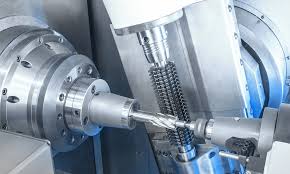
It ensures the production of high-quality gears, which are crucial for the reliable and efficient operation of gearboxes. Gear hobbing is a fundamental process in the industrial gearbox production process. Let’s introduce gear hobbing and discuss its significance in the manufacturing of industrial gearboxes. The machining technique called gear hobbing is essential to building the core of our industrial gearboxes. It entails carving out the complex teeth that are essential to gear performance using a specialized cutting tool called a hob. The employment of a specialized cutting tool is critical to the operation of gear hobs.. In order to create the required gear tooth profile, gear hobbing is a continuous machining technique that makes use of both rotary and linear motion.
Efficiency in Mass Production:
The procedure of gear hobbing is quite effective, especially when making a lot of gears with the same specs. Continuous cutting is made possible, reducing gear-to-gear downtime and enabling high-volume production. Excellent accuracy and precision are provided by gear hobbing. Consistent tooth profiles and dimensions are guaranteed by the use of CNC-controlled machinery, producing gears with precise tolerances and dependable operation. Numerous gear types, including spur, helical, and more, can be produced by gear hobbing. It makes it possible to design gears with various tooth profiles and helix angles to meet the needs of certain applications.
Smooth Tooth Profiles:
The hob’s constant cutting action produces gears with smooth tooth profiles. Hence, the gears have superior meshing properties and produce less noise when in use. It results in gears with a smooth surface, negating the need for extra finishing steps. It helps to increase the gear manufacturing process’s overall efficiency.
In order to save time and money during the production process, the gear hobbing process frequently creates gears with such high precision that secondary finishing operations may be minimal or unnecessary. When it comes to mass production, gear hobbing is more affordable than other gear manufacturing techniques. It provides better material utilization, a higher production rate, and lower tooling costs. Gear hobbing lowers the possibility of dimensional variances and guarantees constant gear quality from one production batch to the next by guaranteeing consistency and repeatability in gear production.
High Load-Carrying Capacity:
The precise tooth shape, hobbing-made gears, has a high load-carrying capacity. Then they are appropriate for heavy-duty applications. Due to working with a variety of steels, alloys, and non-ferrous metals, it is possible to choose the best material for a given set of application requirements.
Conclusion:
It enhances industrial gearbox longevity and overall performance. The gear hob manufacturers in India take great satisfaction in providing industrial gearboxes of the highest caliber. Gear hobbing is a crucial behind-the-scenes procedure that guarantees the accuracy and dependability of our goods. Hence it is a hard and popular technique in contemporary gear manufacture because of its accuracy and efficiency. Due to its adaptability and capacity to create high-quality gears with a variety of tooth profiles. Then, it is well-suited to satisfy the needs of numerous sectors where accuracy and dependability are critical in gear applications.