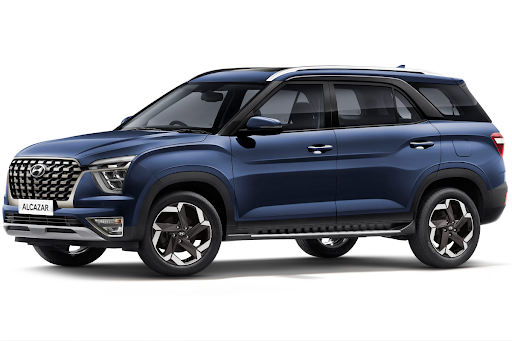
The Hyundai ALCAZAR is positioned as a premium three-row SUV that balances performance, comfort, and versatility. For buyers in this segment, performance is not only about speed. It is about how confidently the vehicle responds in city traffic and how stable it feels during long highway drives. Engine responsiveness, transmission performance, traction control, and overall ride stability all play a key role in determining ALCAZAR’s performance and its real-world usability.
Engine and Powertrain Overview
Hyundai offers the ALCAZAR with two 1.5-litre engine options. The 1.5-litre Turbo GDi petrol engine produces 160 PS of power and 253 Nm of torque. The 1.5-litre CRDi diesel engine delivers 116 PS and 250 Nm of torque. These numbers show that the setup focuses on smooth, usable power instead of high performance.
Transmission choices include a 6-speed manual gearbox for both engines. The petrol engine is also available with a 7-speed Dual-Clutch Transmission (DCT), while the diesel engine offers a 6-speed automatic option. Hyundai positions these combinations to ensure smooth response in daily driving conditions, supporting both urban movement and highway cruising without abrupt power delivery.
Drive Modes and Performance Character
The Hyundai ALCAZAR features multiple drive modes that adjust throttle sensitivity and power response. Hyundai offers Eco, Normal, and Sport modes to help drivers adapt performance behaviour to road conditions.
- Eco mode reduces throttle sensitivity and optimises response for fuel-efficient driving. This setting suits city traffic, where frequent stops and slower speeds benefit from smoother, controlled acceleration.
- Normal mode offers a balanced throttle response. It is designed as the standard setting for everyday driving, making it well-suited for regular city traffic and relaxed highway cruising.
- Sport mode sharpens throttle response. This enhances the acceleration feel and supports more confident overtaking on highways. The sharper response can also be useful when immediate power delivery is required.
These modes allow buyers to adjust engine response according to traffic flow and road conditions, offering a more adaptable and personalised driving experience.
Traction Control and Stability Systems
Hyundai equips the ALCAZAR with traction control modes designed to adapt to varying surface conditions. These systems adjust power delivery to improve grip when road conditions change, whether due to uneven city patches or varied highway surfaces.
The Drive Traction system enhances stability by adjusting power delivery based on road conditions. It helps maintain a better grip and control when the surface changes. Traction control modes such as Snow, Mud, and Sand adapt the ALCAZAR’s response to challenging terrain. Each mode fine-tunes power and traction to improve stability and grip.
In variants where available, paddle shifters provide manual control over gear selection. This allows drivers to hold gears for stronger acceleration or use engine braking when needed, particularly during highway overtakes or downhill driving.
Together, these systems are designed to enhance stability and driver confidence without altering the SUV’s comfort-oriented focus.
Handling, Suspension, and High-Speed Stability
Hyundai’s emphasis on ride comfort combined with stable handling. The suspension setup is tuned to maintain composure while absorbing road irregularities. In city conditions, this supports smoother movement over speed breakers and uneven surfaces.
At highway speeds, the focus shifts to stability. Hyundai positions the ALCAZAR as steady and controlled during cruising. Electronic stability control helps maintain balance, particularly during sudden steering inputs or hard braking at higher speeds.
The steering calibration prioritises ease of control rather than sharp feedback. This suits urban parking and traffic navigation while still providing reliable handling at speed. Overall, the ride character reflects Hyundai’s intent to balance comfort with confidence, suitable for family use rather than performance-focused driving.
Fuel Efficiency and Everyday Practicality
Performance in a family SUV must align with efficiency. Hyundai links Eco mode to optimised fuel usage by moderating throttle input. This can support lower consumption during daily city commutes where traffic flow is inconsistent.
For highway travel, steady power delivery from both engines helps maintain cruising speeds without excessive strain. The diesel engine, with its 250 Nm of torque, is positioned for sustained long-distance travel and improved efficiency under consistent driving conditions.
Hyundai’s performance strategy indicates that the ALCAZAR aims to deliver usable power without compromising practicality. Efficiency remains integrated into the overall driving experience rather than treated as a separate consideration.
Conclusion
The Hyundai ALCAZAR is designed to deliver balanced and confident performance rather than outright sportiness. Its official specifications highlight practical engine options, adaptable drive modes, and stability-focused systems suited for real-world driving conditions.
For buyers seeking a three-row SUV that handles city traffic comfortably and remains stable on highways, ALCAZAR’s performance setup aligns well with everyday driving. However, a test drive is the best way to understand how these features translate into your own driving experience.