No Indian city moves up and down as much as Mumbai does. Land ran out decades ago, so the city grew skyward — and today the average Mumbaikar spends a meaningful slice of every single day inside a lift or on an escalator.
That simple fact is why working with a specialist lift advertising company in Mumbai has become one of the smartest hyperlocal media decisions a brand can make. And why escalator media in malls and transit hubs deserves the same attention.
Two Formats, One Principle
Both lift and escalator advertising work on the same underlying logic: place the message where the audience is stationary, unhurried and has nothing competing for their eyes.
Elevator advertising puts a poster — usually around 13″ x 19″ — or a digital panel inside residential and commercial lift cabins. The rider is enclosed for 20 to 60 seconds with no alternative view. The same household sees the creative multiple times a day, every day of the campaign.
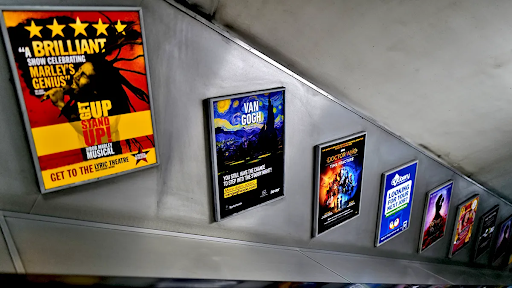
Escalator advertising uses the balustrade panels, step risers, side walls and landing areas of escalators in malls, metro stations and large commercial complexes. Here the viewer is moving slowly, at a fixed pace, looking forward and downward — precisely where the ad sits. The best escalator advertising agency Mumbai brands work with will use this to catch people in the middle of a shopping or commuting mindset, seconds before a purchase decision.
Together, they cover the two halves of a Mumbaikar’s day: the home tower and the public space.
Why Mumbai Is Uniquely Suited to This Medium
Extreme vertical density. From Lower Parel and Wadala to Powai, Malad, Thane, Chembur and Navi Mumbai, the city is defined by 20-to-60-floor towers. A single complex can house more families than an entire neighbourhood in a smaller city — all funnelled through the same lift lobbies.
Long ride times. Height means duration. A ride to the 34th floor gives your creative far longer than the national average dwell time. In Mumbai, the medium simply performs harder than it does elsewhere.
Sharp socio-economic segmentation. Mumbai’s buildings are unusually well-stratified. A tower in Bandra West, a township in Ghodbunder Road and a complex in Kharghar serve entirely different audiences. Society-level buying lets you match your product to exactly the right income band.
Enormous mall and metro footfall. Mumbai’s malls and expanding metro network push huge volumes through escalators daily — an audience already out with their wallets.
Where Each Format Fits Best
Choose residential lift advertising when you need repeat exposure to households: food delivery, clinics, schools, salons, home services, real estate launches, insurance, banking and D2C subscription products.
Choose escalator advertising when you need volume and immediacy: retail store launches, fashion and footwear brands, electronics, F&B outlets inside the mall, films and events, telecom and fintech app installs.
Use both when you want a full-funnel local push — awareness at home, reminder at the point of purchase. Brands that layer the two typically report noticeably stronger recall than either alone.
What Separates a Good Agency From a Cheap Vendor
Mumbai has no shortage of people willing to sell you lift space. Very few can execute properly across a city this fragmented. Use these checks:
Inventory ownership. Does the agency hold direct agreements with societies and mall operators, or is it reselling someone else’s inventory? Direct tie-ups mean stable pricing, guaranteed placement and no mid-campaign disappearances.
Transparent society mapping. You should receive building names, locations, tower counts, lift counts and household estimates before you pay. Round numbers with no list attached are a warning sign.
Verified installation. Geo-tagged, dated photographs from every location, plus periodic re-audits. Mumbai campaigns often span dozens of buildings across three or four suburbs — without documentation, you are trusting blindly.
Creative that suits the format. A lift poster and an escalator riser are read in seconds, in bad lighting, at an angle. Agencies that manage creative and installation as one workflow consistently produce better outcomes than those who only sell space.
Track record at scale. Look at the categories and brands an agency has already handled. A quick look at the clients an agency has worked with tells you more than a pitch deck.
Designing for Mumbai Lifts and Escalators
Practical rules that repeatedly separate high-response creatives from wasted spend:
- Single message. One offer, one benefit, one action. Never a mini-brochure.
- Heavyweight fonts, high contrast. Stainless steel cabins, mirrored panels and harsh tube lighting destroy thin type and pastel palettes.
- Place the call-to-action at eye height. In lifts, the lower third is often blocked by other riders; in escalators, panels are read at a downward angle.
- QR codes need size and quiet space. A cramped QR in a moving environment simply will not get scanned.
- Localise the copy. “Now open in Andheri West” outperforms “Now open in Mumbai” by a wide margin.
- Rotate every 30 days. Familiarity becomes invisibility fast in a space people ride daily.
Measuring Return, Not Guessing It
The biggest myth about lift and escalator advertising is that it is unmeasurable branding spend. It is not, provided you build tracking into the creative:
- Assign a unique promo code or QR to each society or mall cluster.
- Route scans to a dedicated landing page so traffic can be isolated in analytics.
- Use a separate WhatsApp or call number for the campaign.
- Compare walk-ins, calls and orders against a pre-campaign baseline for the same catchment.
Do this and within 30 days you will know which suburbs, which societies and which creatives actually produce revenue — and you can reallocate the next month’s budget accordingly.
Final Thoughts
Mumbai’s advertising market is loud, crowded and expensive. The elevator lobby and the escalator landing remain two of the few places where a brand still gets a fair hearing — repeatedly, in context, and at a cost that local businesses can sustain month after month.
LiftUp has been building brands inside elevators since 2017, combining direct society access, in-house creative and verified installation reporting. Learn more about our approach to elevator media or request a society-wise plan for your Mumbai catchment.
FAQs
Q1. What is the difference between lift advertising and escalator advertising? Lift advertising targets enclosed elevator cabins in residential and office towers for repeat household exposure. Escalator advertising targets high-footfall public spaces like malls and metro stations for volume and point-of-purchase impact.
Q2. Can I run a campaign in only one suburb of Mumbai? Yes. Suburb, society and even single-building targeting is standard, which is what makes the medium suitable for neighbourhood businesses.
Q3. How long does an escalator advertising campaign usually run? Most mall and transit escalator campaigns run in 30-day cycles, often aligned with festive periods, sale seasons or product launches.
Q4. Is lift advertising allowed in all housing societies? Only where the agency holds a valid agreement with the managing committee. Always confirm the society list and permissions before booking.
Q5. What budget should a small Mumbai business start with? Begin with a single locality cluster for 30 days, measure response through a unique code, then scale into adjacent suburbs once the numbers justify it.