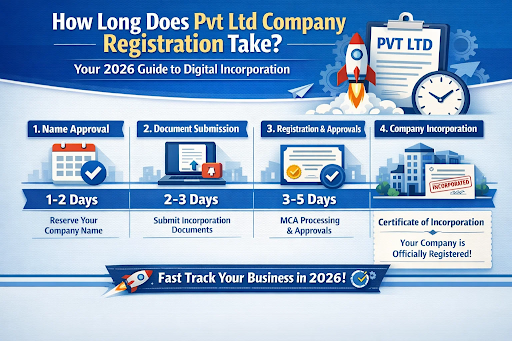
Embarking on the entrepreneurial journey in India is an exciting step, and choosing the right legal structure is crucial. For many ambitious founders in 2026, a Private Limited Company (Pvt Ltd) remains the gold standard due to its limited liability and fundraising potential. But with multiple digital platforms and streamlined processes, a common question arises: “How long does pvt ltd company registration in india actually take?”
The quick answer is a definitive YES, you can register a Pvt Ltd company entirely online. In 2026, the online route via the Ministry of Corporate Affairs (MCA) V3 portal is the standard and most efficient path. This digital first-approach, often facilitated by expert startup registration services, has revolutionized the ease of starting a business in India, allowing founders to focus less on paperwork and more on building their dream.
But “online” doesn’t mean instantaneous. There are sequential legal and administrative steps involved, each with its own timeline. This guide breaks down exactly what to expect and how to estimate your path to incorporation.
The Realistic Timeline: 7 to 15 Working Days
Under normal circumstances, and assuming all documentation is prepared correctly and submitted without errors, the entire process—from obtaining the first digital key to receiving your final certificate—typically takes between 7 and 15 working days.
While simplified, integrated application forms like SPICe+ exist on the MCA portal, the ultimate timeline heavily depends on external factors, primarily how unique your proposed company name is and the accuracy of your information.
Detailed, Step-by-Step 2026 Timeline
The Pvt Ltd registration process is structured as a series of sequential hurdles; one step often must complete before the next can begin. Professional startup registration services often run some of these steps concurrently to save you time.
Day 1–2: Digital Signatures & DIN
The entire process is electronic. To sign the legal documents, every proposed director must have an active Digital Signature Certificate (DSC) and apply for a Director Identification Number (DIN). These are digital prerequisites that must be in place before any forms can be filled.
- Action: Apply for DSC and DIN for all founders.
Day 3–5: Name Reservation (The SPICe+ Part A Stage)
This is a crucial, often iterative stage. Your company name must be unique, non-offensive, and must not violate existing trademarks. You’ll use the integrated SPICe+ web form on the MCA portal specifically for this purpose.
- Action: Submit the SPICe+ Part A application. It is highly advisable to submit 2 to 3 alternative names.
- Time Factor: If the Ministry (MCA) rejects the names due to similarity, you must re-submit new options, essentially resetting this phase’s clock. Choosing an obscure, distinct name significantly speeds this up.
Day 6–8: Document Preparation (MoA, AoA, & Declarations)
Once your unique name is approved, the main filing begins. This involves drafting the key constitutional documents: the Memorandum of Association (MoA) and Articles of Association (AoA).
- Action: These define your company’s constitution and internal rules. Professional draftsmen customize these to align with your specific business goals. The final documents, along with utility bills, declarations of intent, and ID proof, must be finalized and uploaded to the portal.
Day 9–15: Final ROC Review & Certification (SPICe+ Part B)
This is the final hurdle. All prepared documents, declarations, and the chosen capital structure are bundled into the final SPICe+ Part B form and submitted to the Registrar of Companies (ROC).
- Action: Pay the requisite ROC fees and stamp duty.
- The Output: If the ROC is satisfied, they will issue the Certificate of Incorporation (COI). In 2026, this COI simultaneously triggers the issuance of your Permanent Account Number (PAN) and Tax Deduction and Collection Account Number (TAN), and potentially GST registration depending on your selection.
Key Variables that Affect the Speed
Even with the streamlined online portal, the timeline for your pvt ltd company registration in india can vary based on specific circumstances:
Factors That Accelerate the Process:
- Unique Names: A highly distinct name that doesn’t conflict with existing brands gets approved instantly.
- Standardized AoA/MoA: While customization is crucial, using standard templates as a base can speed up drafting and subsequent review.
- Accurate KYC: Mismatched details in KYC documents (like address differences between Aadhaar and an electricity bill) are the #1 cause of government query and rejection. Ensuring all your documents have consistent information is key.
Factors That Slow Down the Process:
- Government Holidays: ROC offices do not work on weekends or public holidays. A submission before a long weekend can add 4 days to the timeline.
- Resubmissions: Any error in your application or documentation results in the ROC requesting “resubmission,” which essentially restarts their 24–48 hour review clock.
Why the Timeline is Worth it for a Pvt Ltd
While other forms of business (like a sole proprietorship) have faster setup times (often 2–3 days), the 7–15 day investment for pvt ltd company registration is crucial for long-term growth.
This structure provides investors with a clear exit strategy (shares), is required for many large vendor contracts, and, crucially, offers limited liability protection to the founders, separating their personal assets from business risks. In the dynamic landscape of 2026 startups, this peace of mind is invaluable.
Conclusion
Yes, you can register a Pvt Ltd company online. In 2026, it’s the expected and most effective way to establish your business as a legal entity. Leveraging the streamlined online portal and opting for specialized startup registration services transforms what could be a bureaucratic challenge into a strategic step, paving the way for your venture’s success.