A surgeon once told me the worst moment in any operation isn’t the bleeding. It’s the shadow. That half-second where a head leans in, an assistant shifts, and the one spot that needs light the most suddenly goes dim.
That’s the problem a good operating light is built to solve. And most people buying one for the first time underestimate just how much engineering goes into getting it right.
So let’s break it down — what actually matters when you’re choosing surgical lighting, and what’s just brochure talk.
Start with shadow management, not brightness
Everyone asks about lux first. Understandable. But raw brightness is only half the story. What separates a hospital-grade light from a glorified lamp is how it handles obstruction.
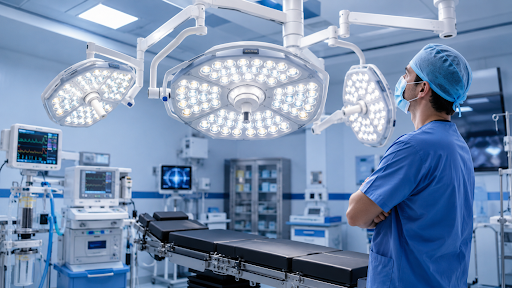
Modern shadowless OT lights use a cluster of LEDs set at different angles, so when one beam gets blocked, the others fill the gap. The surgical field stays evenly lit even with three pairs of hands in the way. A flat, single-source lamp can’t do that. Neither can most cheap imports that look the part but cut corners on the optics.
Then look at the numbers that actually matter
Lux at the surgical site usually sits somewhere between 40,000 and 160,000. More isn’t automatically better — too much intensity causes glare and tires the surgeon’s eyes over a long case. What you really want is adjustability, so the team can dial it to the procedure in front of them.
Colour temperature is the one people forget. Around 4,300K is the sweet spot — close to natural daylight — which means tissue looks like tissue, not something washed yellow or clinically blue. Pair that with a colour rendering index above 95 and the surgeon can actually tell healthy tissue from the parts that aren’t.
Heat is the quiet dealbreaker. Old halogen heads baked the surgical field. LED changed that. A well-built LED light keeps the working area cool, which matters far more than people expect during procedures that run for hours.
One more thing worth checking: depth of illumination. A good light keeps a deep cavity lit without the surgeon having to constantly reposition the head. In a narrow abdominal or orthopaedic field, that single feature can quietly save twenty minutes a case.
Don’t buy the light in isolation
Here’s the thing nobody mentions. Your lighting has to work with the table.
If the light and the platform aren’t designed to coordinate — beam reach, positioning arc, the way the head swings over the patient — you end up fighting your own equipment. This is why a lot of hospitals now source their surgical OT tables and lights together, from a manufacturer that builds them as one system rather than separate parts. It saves a surprising amount of grief down the line.
Installation, service, and the ten-year view
A light is a ten-year decision, not a one-time purchase. Ask about the warranty. Then ask harder about service response time. A premium light that takes three weeks to repair is worse than a modest one that gets fixed in two days.
Indian manufacturers have closed the quality gap dramatically here. Companies like Ventek India now ship CDSCO-registered, FDA-aligned surgical lighting to dozens of countries — and the after-sales network on home ground tends to be far quicker than waiting on imported spares.
A quick word on certification
Don’t skip this. For any device entering an operating room, regulatory clearance isn’t a formality — it’s proof the thing was tested to do what it claims. CDSCO registration in India, plus international certifications, tells you the optics, the electricals, and the build have all been independently checked. If a supplier gets vague when you ask for certificates, that’s your answer.
Frequently asked questions
How many lux does an OT light need? Most procedures are comfortable in the 40,000 to 160,000 lux range at the surgical site, with the ability to adjust down for delicate work.
Are LED OT lights better than halogen? For nearly every modern theatre, yes. LEDs run cooler, last far longer, render colour more accurately, and cost much less to run over time.
Can one light cover every surgery type? A single ceiling unit handles general surgery well, but high-demand departments often add a satellite head for deep-cavity and dual-surgeon procedures.
The bottom line
Buy for the long surgery, not the demo. The light that looks fine for ten minutes in a showroom is a different animal at hour four of a complex case. Get the shadow control right, match it to your table, check the certifications, and pick a manufacturer who will still pick up the phone in year three. That’s the whole game.