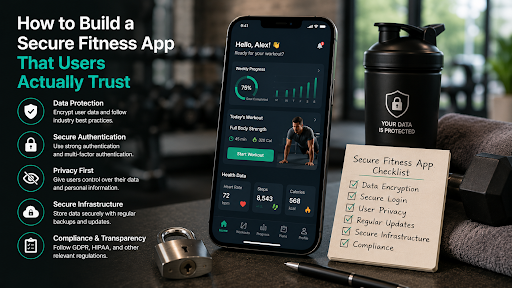
A fitness app asking for your heart rate, your location, your sleep patterns, your weight history, and your menstrual cycle is asking for some of the most personal data a person generates. Most users know this on some level. They hand it over anyway because the app is useful, or because everyone else is using it, or because they haven’t thought too carefully about where that data actually goes.
Then a breach happens somewhere in the industry, or a privacy policy update surfaces that nobody expected, and suddenly the reviews fill up with people saying they never felt comfortable with it but used it anyway. That discomfort was always there. It just needed a reason to surface.
Building a fitness app that earns genuine trust rather than passive tolerance is a different design problem than building one that just works. Any experienced fitness app development company will tell you security and privacy aren’t features you add at the end – they’re architectural decisions made at the start that shape everything else. Here’s what those decisions actually look like in practice.
The Data Problem Is Worse Than Most Teams Acknowledge
Fitness apps collect health data, and health data is not like other data. Under HIPAA in the United States, GDPR in Europe, and similar frameworks in other jurisdictions, health-related information carries stricter handling requirements than most other personal data categories. A workout tracking app that stores heart rate data, sleep cycles, or menstrual health information is operating in regulated territory whether it thinks of itself that way or not.
The first architectural decision worth making explicitly is what data the app actually needs versus what it could collect if given the chance. These two things diverge more than most product teams admit. An app that tracks running routes needs GPS data during a workout. It probably does not need to store a complete history of every location a user has ever been, with timestamps, indefinitely. Collecting less data to begin with is the most underrated security practice there is, because data you never collect cannot be breached, subpoenaed, or misused.
Data minimization sounds obvious when stated plainly. It runs directly against the instinct of most product teams to collect everything now and figure out what to do with it later. Deciding upfront what gets collected, why it’s needed, how long it’s kept, and when it gets deleted is less exciting than building features but it’s foundational to trust.
Encryption Is Table Stakes, Not a Differentiator
Every serious fitness app in 2026 encrypts data in transit using TLS 1.2 or higher. This is the baseline. The gap between apps that earn user trust and apps that don’t is usually in what happens to data at rest.
Health data stored on a server should be encrypted at the database level, not just at the application layer. Encryption keys should be managed separately from the data they protect. On the device itself, sensitive data stored locally should use the platform’s secure storage APIs, the iOS Keychain and Android Keystore respectively, rather than plain local storage or SharedPreferences. These aren’t exotic requirements. They’re standard practices that a surprising number of fitness apps skip because nobody explicitly decided to implement them and the app works fine without them in testing.
Biometric authentication as a second factor is worth implementing for any app holding meaningful health data. Face ID and Touch ID integrations are straightforward on both iOS and Android, and users who care about security appreciate not having to choose between convenience and protection.
Third-Party SDKs Are the Blind Spot
A fitness app typically integrates a dozen or more third-party SDKs by launch: analytics, crash reporting, advertising, social sharing, payment processing. Each one is a potential data pathway that the development team didn’t build and may not fully control.
This matters because health data collected by the app can flow through analytics SDKs to third-party servers in ways that aren’t obvious from the user’s perspective. A user who consented to sharing their workout data with the app did not necessarily consent to having it analyzed by an advertising platform’s machine learning models. Several high-profile fitness apps have faced regulatory scrutiny and public backlash specifically over this gap.
The practical approach is a strict SDK audit before launch and at each major update: what data does each SDK have access to, where does that data go, and does that match what the privacy policy says. Permissions granted to the app should be explicitly scoped before being passed to any third-party library. This is tedious work. It’s also the kind of thing that surfaces in regulatory audits and journalism investigations, so it’s worth doing properly.
Transparent Privacy Controls Build More Trust Than Privacy Policies
Nobody reads privacy policies. This is not a controversial observation. What users actually respond to is whether the app makes them feel in control of their own data in the moments when they’re using it.
Granular consent at the point of collection, not buried in an onboarding flow they clicked through in thirty seconds, makes a real difference. A screen that says “this app would like to access your Health app data to track your workouts, your sleep, and your heart rate” with separate toggles for each category signals something about how the app thinks about the relationship. A single permission request for “health data” signals something else.
In-app data management, specifically the ability to see what’s stored, download it, and delete it permanently, is now expected by users who think about these things. GDPR mandates it for European users. Building it properly for everyone rather than as a compliance checkbox for one jurisdiction is the kind of decision that shows up in app store reviews in ways developers don’t always expect.
What Happens When Things Go Wrong
A security incident response plan is not something most fitness app teams have written down before launch. It should be. The questions worth answering in advance: how will users be notified if their data is involved in a breach, what’s the timeline, who is responsible for that communication, and what regulatory bodies need to be informed under which timeframes. GDPR requires notification to relevant authorities within 72 hours of becoming aware of a breach. HIPAA has its own notification requirements. Discovering these requirements for the first time in the middle of an incident is a bad time to learn them.
Penetration testing before launch and at regular intervals afterward is standard practice for any app handling sensitive health data. Static analysis tools like Checkmarx or Veracode catch common vulnerability classes early. Dependency scanning flags known vulnerabilities in third-party libraries before they make it into production.
The Cost of Getting This Right
Fitness app development cost goes up meaningfully when security is built in rather than bolted on. Proper encryption implementation, SDK auditing, penetration testing, and a genuine privacy control UX all add time and money to the initial build. The more useful framing is what it costs to get it wrong: regulatory fines under GDPR can reach four percent of global annual revenue, a data breach in a health data context triggers mandatory notification costs and almost certainly results in user churn, and rebuilding trust after a public privacy incident is significantly harder than building it in the first place.
The apps in the fitness space that have the strongest user retention tend to be the ones where users feel the app is on their side. That feeling is not manufactured through marketing. It comes from consistent, visible evidence over time that the app handles their data carefully, gives them real control, and treats their health information with the seriousness it deserves.
Where to Start
If the app is in early development: make data minimization decisions before the schema is built, not after. Choose an architecture that makes encryption at rest straightforward from the start.
If the app already exists: audit what data is being collected versus what the product actually needs, review what third-party SDKs have access to, and assess whether the in-app privacy controls match what the privacy policy claims they are.
In both cases: the users who care most about this are also, consistently, the most engaged users. Building for their expectations is not a compliance exercise. It is, in most fitness app categories, a competitive advantage that compounds over time.