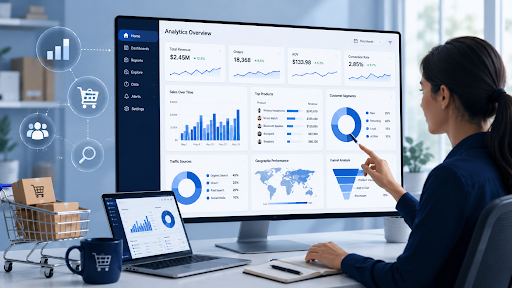
Something fundamental has shifted in how ecommerce businesses relate to their data. For years, analytics was a centralized function — a team of analysts who owned the data, ran the queries, and produced the reports. Everyone else was a consumer of their outputs.
Self-service analytics has flipped this model entirely. Today, the most effective ecommerce operations are ones where insight generation is distributed across the organization — where marketing, operations, finance, and product teams can all access, analyze, and act on data independently.
The Old Analytics Bottleneck
The traditional model had a fundamental flaw: it did not scale. As businesses grew, data questions multiplied faster than analyst headcount. Request queues grew. Reports arrived late. By the time insights reached decision-makers, the window for action had often passed.
The frustration was mutual. Analysts spent most of their time on routine reporting rather than strategic analysis. Business teams felt blocked. Neither group was working at their highest value.
What Self-Service Analytics Looks Like Today
Modern self-service analytics platforms provide non-technical users with drag-and-drop report builders, pre-built dashboard templates, and natural language query interfaces. A marketing manager can build a campaign performance report in minutes. An operations director can monitor fulfillment KPIs in real time. A finance lead can pull revenue breakdowns by product line without submitting a single ticket.
The data team’s role does not disappear — it elevates. Instead of building routine reports, they focus on data modeling, governance, and the complex analytical work that genuinely requires specialist expertise.
The Role of AI in Self-Service
AI has dramatically extended the power of self-service analytics. Natural language interfaces now allow users to ask questions in plain English and receive data-backed visual answers instantly. Anomaly detection surfaces unexpected patterns without anyone having to look for them. Automated insights arrive proactively in dashboards and email digests.
This combination of accessibility and intelligence means that even users with no analytical training can develop genuine data fluency over time — not because the tools make analysis trivial, but because they make analysis approachable.
Connecting Self-Service to Forecasting
One of the highest-value applications of self-service analytics in ecommerce is giving non-technical teams access to predictive analytics for sales. When inventory managers can run their own demand forecasts, or when marketing managers can model the revenue impact of a planned campaign, the quality of planning across the organization improves dramatically.
Governance: The Necessary Counterbalance
Self-service analytics works best when it operates within a strong data governance framework. Without it, different teams end up with different versions of the truth, conflicting reports, and eroded trust in the data.
Good governance means establishing single sources of truth for key metrics, implementing role-based access controls, and creating clear data dictionaries that ensure every user is working from the same definitions.
Measuring the Impact
Businesses that successfully implement self-service analytics consistently report three outcomes: faster decision cycles, reduced analyst bottlenecks, and improved cross-functional collaboration. When everyone is working from the same real-time data, alignment happens naturally and disputes based on different report versions disappear.
Conclusion
Self-service analytics is not a cost-cutting measure — it is a capability multiplier. When every person in your organization can access the data they need to do their job better, the cumulative effect on decision quality and business performance is significant. For ecommerce brands competing in a fast-moving market, this kind of organizational data fluency is increasingly a requirement, not a nice-to-have.