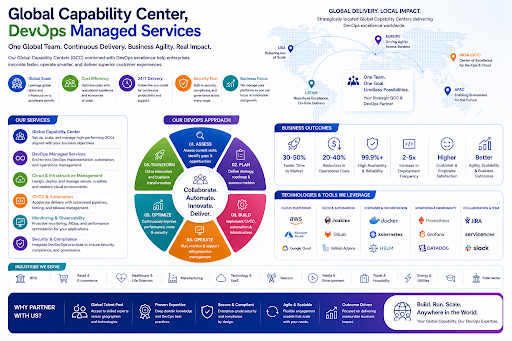
As enterprises push for faster releases and more resilient systems, the question of who runs DevOps at scale becomes just as important as which tools they use. A global capability center offers a compelling answer — providing dedicated, skilled teams that deliver devops managed services around the clock, without the coordination overhead of juggling multiple vendors across different time zones.
This model has become mainstream across industries. Large banks, retailers, healthcare firms, and manufacturers are consolidating fragmented DevOps operations into dedicated GCCs to gain both scale and consistency. The pattern is clear: as software delivery becomes central to competitive advantage, so does the discipline of running that delivery well.
Why DevOps at Scale Needs a Dedicated Operating Model
Devops managed services require consistency — the same standards for infrastructure-as-code, release automation, and monitoring applied across every application and environment. When this responsibility is scattered across regional teams or multiple vendors, standards drift and incidents multiply. Every team invents its own conventions, and knowledge does not travel.
A global capability center solves this by centralizing DevOps expertise into a single, well-governed team that maintains consistent standards while still providing regional and around-the-clock coverage. Standards live in one place; adoption happens everywhere.
Consistency Without Sacrificing Speed
Centralizing devops managed services within a GCC does not mean slowing down regional teams — it means giving every region access to the same automated pipelines, tooling, and best practices. Regional teams keep their autonomy on product decisions while gaining a stable platform beneath them.
Building Deep Platform Expertise Over Time
A dedicated GCC team develops institutional knowledge of the enterprise’s specific infrastructure and release patterns that a rotating cast of external vendors rarely achieves. This depth compounds over time into a genuine competitive advantage.
Operational Advantages of a GCC-Led DevOps Model
Beyond consistency, a global capability center brings practical operational advantages: follow-the-sun incident response, dedicated capacity for platform engineering work that often gets deprioritized in smaller teams, and a stable pipeline of talent trained specifically on the organization’s systems.
This translates directly into faster releases, more reliable infrastructure, and fewer late-night escalations for regional engineering leaders. It also improves overall engineering morale, since regional teams are no longer expected to be both product engineers and platform engineers simultaneously.
- Centralized infrastructure-as-code standards applied consistently across all environments
- Follow-the-sun coverage for release management and incident response
- Dedicated capacity for platform engineering initiatives often deprioritized elsewhere
- Long-term talent development focused specifically on the enterprise’s technology stack
- Shared observability stack that gives every team the same real-time view of production health
- Standardized runbooks and disaster-recovery drills executed on a predictable cadence
Platform Engineering as the Natural Next Step
The most mature GCC-led devops managed services organizations naturally evolve toward platform engineering — building internal developer platforms that abstract away infrastructure complexity and give product engineers self-service access to reliable environments, deployment pipelines, and observability tools.
This is where the GCC really earns its strategic label. Rather than reacting to tickets, the platform engineering team inside the global capability center proactively raises the ceiling on what every product team in the enterprise can achieve. This is one of the highest-leverage activities in modern enterprise engineering, and it thrives in an environment with dedicated, long-tenure engineers — exactly what a well-run GCC provides.
A Model Built to Scale With the Business
As enterprises add new applications, cloud environments, and regions, a GCC-based devops managed services model scales far more predictably than a patchwork of vendors and regional teams operating independently.
The organizations that get this right treat their global capability center not as a cost play, but as the operational backbone that lets engineering keep pace with business growth. That framing changes how the GCC is staffed, funded, and empowered — and ultimately determines whether it becomes a genuine strategic asset.
Common Pitfalls in Building a GCC-Led DevOps Practice
Enterprises setting up a global capability center for devops managed services often stumble in predictable ways. Recognizing these pitfalls up front prevents years of avoidable rework.
- Positioning the global capability center purely as a cost play, which caps its ability to attract senior talent
- Splitting devops managed services responsibility across the GCC and legacy vendors, so nobody owns the outcome
- Underinvesting in tooling and platform engineering, then expecting the GCC to deliver reliability manually
- Failing to define standards centrally, so each application team invents its own release conventions
- Ignoring career pathing for engineers, driving attrition and eroding institutional knowledge
- Measuring the GCC only by ticket volume rather than by product-team velocity and platform reliability
Best Practices for a High-Performing GCC-Led DevOps Function
The GCCs that consistently deliver strong devops managed services results share a set of disciplines that are less about tooling and more about how the center is run day to day.
- Invest in a strong engineering culture within the GCC — communities of practice, guilds, and internal talks
- Publish clear career ladders so engineers see a long-term future inside the center
- Rotate GCC engineers into product teams periodically to keep context fresh and cross-pollinate ideas
- Measure and celebrate reliability improvements as visibly as feature delivery elsewhere in the enterprise
Actionable Insights for Enterprise Leaders
- Centralize infrastructure-as-code and release standards within the global capability center to ensure consistency at scale
- Design follow-the-sun coverage models to improve incident response without burning out regional teams
- Dedicate GCC capacity specifically to platform engineering work that often gets deprioritized elsewhere
- Invest in long-term training so GCC teams develop deep expertise in the organization’s specific systems
- Position devops managed services delivered from the GCC as a growth enabler, not just a cost play
- Measure GCC success by product-team velocity and platform reliability, not just ticket volume
Conclusion
Devops managed services reach their full potential when delivered through a well-structured global capability center. Enterprises that centralize DevOps expertise this way gain consistency, round-the-clock coverage, and a stable foundation for platform engineering — turning their GCC into a genuine engine for scalable, reliable software delivery.