When it comes to outdoor timber frame construction, few decisions are as foundational as species selection. The wood species determines the structure’s strength, its ability to withstand weather, its visual character, and its long-term maintenance requirements. Douglas fir has occupied the top position in this decision for most North American builders for decades—and understanding why reveals a great deal about what makes a good outdoor timber.
Douglas Fir Wood: Properties That Matter for Outdoor Use
Douglas fir wood is classified as a softwood, but it outperforms many hardwoods in structural applications because of its exceptional strength-to-weight ratio. Its modulus of rupture (bending strength) and compression values make it capable of spanning longer distances without intermediate support than most alternative species—a meaningful advantage in pergola beam design where spans of 10–16 feet or more are common.
The wood’s grain is tight and consistent, which contributes to its dimensional stability as it dries and responds to seasonal moisture changes. Tight grain also means the wood takes stain, sealant, and paint finishes more uniformly than open-grain species, making finishing easier and results more predictable.
Douglas fir’s natural resin content provides moderate biological resistance to fungi and insects—not at the level of cedar or white oak, but meaningful enough to perform reliably in outdoor applications when properly finished and maintained. The resin also contributes to the wood’s warm reddish-brown color and its characteristic aromatic quality when freshly milled.
The Visual Case for a Douglas Fir Pergola
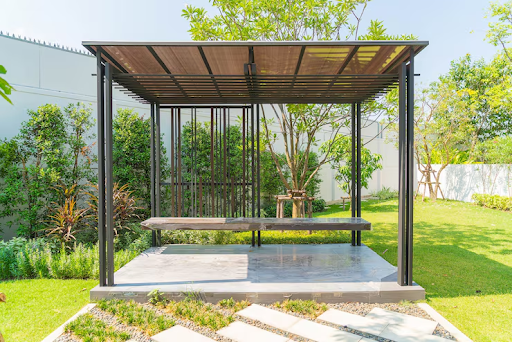
A douglas fir pergola has a specific visual character that alternative materials can’t replicate. The tight grain pattern, subtle color variation, and warm baseline tone create a natural, organic aesthetic that integrates well with most residential architectural styles—from traditional Craftsman to modern farmhouse to contemporary.
When left to weather naturally without finishing, Douglas fir transitions to a silver-gray patina over time. Some homeowners deliberately pursue this weathered look as an intentional aesthetic direction. Others prefer to maintain the wood’s original warm tone with periodic stain application. Both approaches produce attractive results; the decision is purely a matter of personal preference and willingness to commit to a maintenance regimen.
Comparing Douglas Fir and White Oak Pergola Options
Both Douglas fir and white oak pergola construction are popular high-quality choices, but they serve different priorities.
Douglas fir is more readily available in large timber dimensions, more affordable, and lighter—which simplifies installation logistics for large structures. Its structural properties support long spans confidently. It requires finishing to maximize its outdoor longevity but rewards that investment with decades of reliable performance.
A white oak pergola represents a higher-end investment. White oak’s natural tyloses—cellular structures that seal the wood’s pores—make it significantly more water-resistant than Douglas fir without any chemical treatment. Its density and hardness also make it exceptionally resistant to surface wear and damage. The trade-off is cost (white oak is substantially more expensive), weight (heavier to handle during installation), and availability in large timber dimensions.
For buyers who prioritize value, accessibility, and strong structural performance, douglas fir pergola construction is the clearer choice. For buyers focused on maximum longevity with minimal maintenance and for whom budget is less of a constraint, white oak deserves serious consideration.
Finishing a Douglas Fir Pergola
The most important step in maximizing the lifespan of a Douglas fir outdoor structure is finishing before or immediately after installation. All six faces of every timber should be coated, not just the visible surfaces—end grain is particularly vulnerable to moisture penetration and should receive extra attention.
For a natural appearance that protects the wood while allowing the grain to show, penetrating oil finishes or semi-transparent stains are the preferred option. These need to be reapplied every 2–3 years on south-facing or particularly exposed surfaces. For a more opaque look, solid-body stains provide greater UV protection and require less frequent reapplication but obscure the grain character.
Structural Sizing for Douglas Fir Pergola Beams
Beam and post sizing in a Douglas fir pergola should be proportional to both structural requirements and visual weight. For most residential pergola applications, 6×6 or 6×8 posts and 4×8 or 6×8 beams are common specifications. Larger spans or heavier roof loads require engineering input to verify beam sizing is adequate.
Conclusion
Douglas fir wood combines structural capability, visual character, and practical availability in a way that makes it the benchmark species for outdoor timber frame construction. A well-built and properly maintained Douglas fir pergola is a genuinely lasting investment in outdoor living—one that improves with age and provides decades of beauty and utility.